

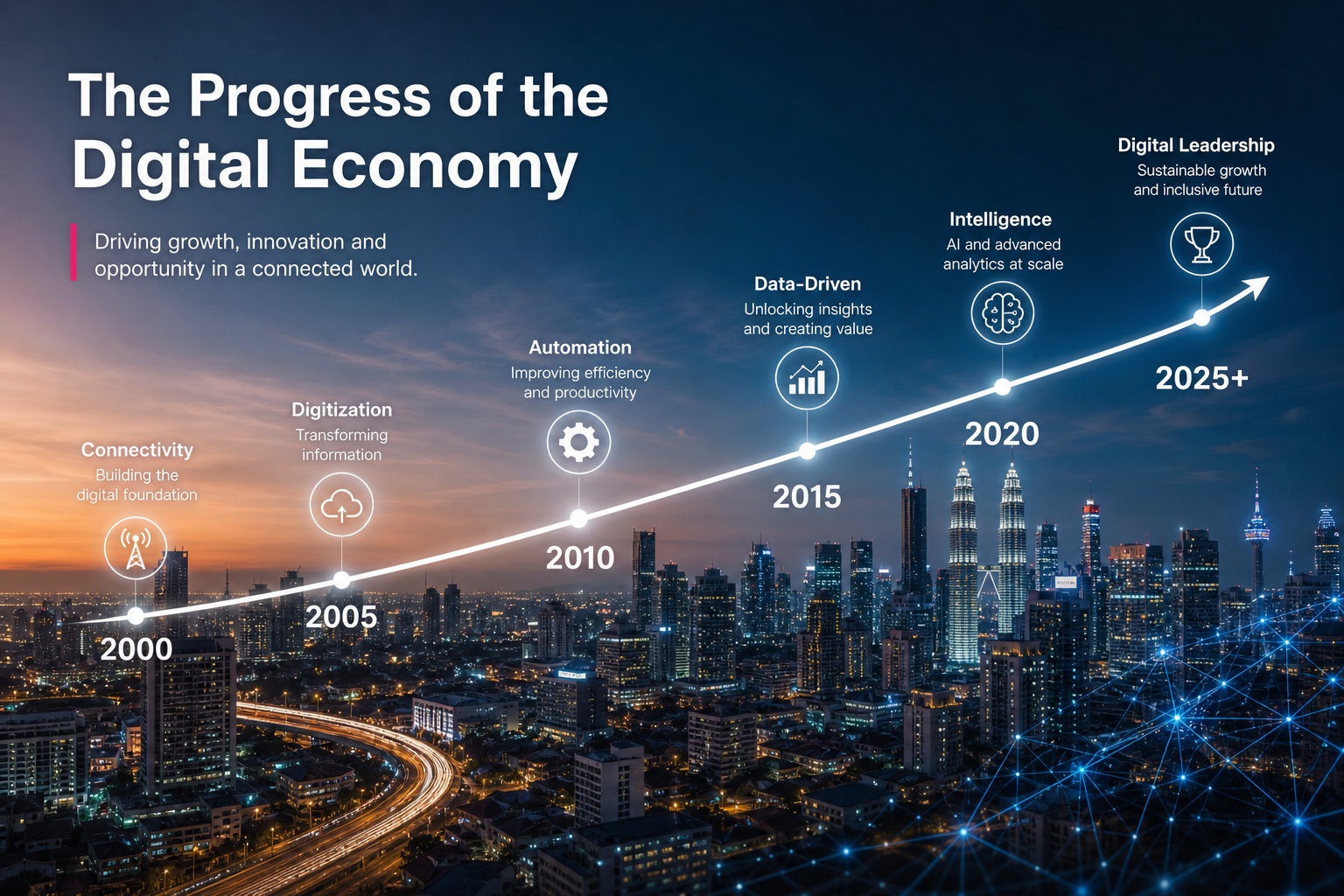
At Khalifa International, we are concerned with a fundamental question: how should nations position themselves in an age where technology increasingly defines economic strength, social structure, and strategic autonomy?
Progress today is no longer measured solely by access to tools, but by the ability to shape them. The distinction between those who adopt and those who build is becoming one of the defining divides of our time.
In this contribution, Mazlan Abbas examines Malaysia’s role in the digital economy through this lens. His argument invites a deeper reflection—not only on capability, but on responsibility: what it means for a nation to move beyond participation and toward meaningful authorship in the systems that shape its future.
”From Consumer to Producer: Rethinking Malaysia’s Role in the Digital Economy

By Dr. Mazlan Abbas, CEO – Favoriot
For many years, Malaysia has demonstrated strong participation in the global digital economy. The nation has shown agility in adopting new technologies, integrating digital tools into everyday life, and embracing innovation across industries. From mobile applications to cloud services, Malaysians have proven to be highly receptive users of technology.
Yet this strength in adoption raises a deeper strategic question.
While Malaysia excels as a consumer of technology, to what extent is it shaping, building, and owning the technologies it depends upon?
This distinction between consumption and production is becoming increasingly consequential. As the global economy shifts toward knowledge-driven and technology-based value creation, nations that primarily consume risk long-term dependency on external innovation. In contrast, those that produce technology gain greater control over their economic direction, intellectual property, and long-term competitiveness.
Understanding the Consumer–Producer Gap
A consumer nation is typically characterised by its ability to adopt and utilise technologies developed elsewhere. This includes integrating imported solutions into local industries, improving productivity through digital tools, and participating actively in global markets.
Malaysia has performed well in this regard. The country has built strong digital infrastructure, supported the growth of e-commerce, and encouraged digital transformation across both public and private sectors.
However, consumption alone has structural limitations.
When technologies are primarily imported:
- Strategic control remains external
- Intellectual property is owned by others
- Local industries depend on foreign platforms and ecosystems
- Economic value creation is partially transferred outside the country
Over time, this creates systemic dependence. While the nation benefits from usage, it does not fully capture the value of creation.
What Defines a Producer Nation Today
In today’s economy, production extends far beyond physical goods. It encompasses the creation of knowledge, systems, and digital infrastructure.
A producer nation is one that:
- Develops its own digital platforms and software systems
- Generates intellectual property in areas such as AI, IoT, and data analytics
- Builds scalable solutions that can be exported globally
- Owns and governs its data ecosystems
- Translates research into real-world applications
Production today is fundamentally about capability—the ability not only to use systems, but to design and direct them.
Moving Up the Value Chain
Malaysia has already established itself as a capable participant in the digital economy. The next step is to move decisively up the value chain.
This involves shifting from:
- Using platforms → building platforms
- Integrating solutions → designing solutions
- Generating data → owning and monetising data
Such a transition is not merely technical—it is strategic. It reflects a move from dependency toward agency.
Nations that build their own platforms and ecosystems are better positioned to:
- Influence industry standards
- Retain economic value within their borders
- Strengthen resilience in critical sectors
- Compete globally with differentiated offerings
Challenges in Transitioning to a Producer Nation
Despite strong talent and infrastructure, several challenges continue to slow Malaysia’s transition.
- Limited Translation from Research to Deployment
Universities and research institutions produce valuable ideas and prototypes, yet many do not progress into scalable, market-ready solutions.
- Ecosystem Fragmentation
Collaboration between academia, industry, startups, and government remains inconsistent. Without strong coordination, efforts remain isolated rather than cumulative.
- Risk Aversion
There is a tendency to favour proven, imported solutions over locally developed alternatives. While this reduces short-term uncertainty, it constrains long-term capability building.
- Dependence on External Platforms
Many local solutions are built on foreign platforms. While this accelerates development, it limits ownership and strategic control.
- Talent Utilisation
Malaysia produces skilled engineers and developers, yet not all are channelled into building original products or platforms. A significant portion contributes to implementation rather than creation.
Technology as Opportunity
Emerging technologies such as the Internet of Things (IoT), Artificial Intelligence (AI), and blockchain present a significant opportunity for Malaysia to reposition itself.
These technologies lower barriers to innovation. With the right platforms and support systems, individuals and organisations can build solutions that scale beyond local markets.
However, the focus must extend beyond adoption.
For example:
- IoT should evolve from monitoring systems toward integrated, end-to-end solutions
- AI should not only be applied but also developed, trained, and adapted locally
- Data should not only be collected but structured, governed, and monetised
This shift requires a change in orientation—from implementation to ownership.
The Importance of Ecosystem Development
No nation transitions into a producer economy in isolation. It requires a coordinated and aligned ecosystem.
Universities
Institutions must go beyond theory and encourage students to build real-world solutions through industry-linked projects, innovation labs, and entrepreneurship programmes.
Industry
Companies should invest in local innovation, collaborate with startups, and provide deployment pathways for emerging solutions.
Government
Policies should support experimentation, reduce barriers to innovation, and incentivise local technology development.
Platforms
Accessible platforms are essential to lower entry barriers for developers and startups, enabling faster prototyping and deployment.
When these elements align, ideas move more effectively from concept to implementation.
Control, Security, and Resilience
The transition from consumer to producer carries implications beyond economics.
As systems become increasingly interconnected and data-driven, issues such as cybersecurity, data sovereignty, and system resilience become critical.
Reliance on external technologies introduces exposure to risks that may not be fully within national control. Building local capabilities strengthens:
- Control over critical infrastructure
- Governance of data
- Long-term resilience and adaptability
A Pragmatic Path Forward
The shift toward becoming a producer nation does not require immediate large-scale transformation. It can begin with focused, incremental steps:
- Encourage local solution development in targeted sectors such as smart cities, agriculture, and industrial automation
- Support startups that build platforms, not just applications
- Promote industry adoption of locally developed technologies
- Strengthen collaboration between academia and industry
- Build confidence in local capabilities through visible success stories
Small, consistent gains can generate momentum for broader systemic change.
Redefining National Success
Malaysia’s digital progress should not be measured solely by adoption rates or user numbers.
More meaningful indicators include:
- The number of locally developed platforms
- The extent of intellectual property created within the country
- The ability to export technology solutions
- The strength of local innovation ecosystems
These reflect not just participation, but capability and long-term sustainability.
Conclusion
Malaysia stands at an important crossroads in its digital journey. The foundations for growth are already in place—strong infrastructure, capable talent, and widespread digital adoption.
The next phase requires a deliberate shift in focus.
Moving from a consumer nation to a producer nation is not about rejecting external technologies. It is about balancing adoption with creation—ensuring that Malaysia does not merely participate in the digital economy, but actively shapes it.
The opportunity is clear. What remains is the commitment to build, to own, and to lead.